NEW YORK -- Haut.AI, a SaaS technology company specializing in AI-powered skin analysis and personalized skincare, unveiled its Skin Foundation Model (SkinFM). The new image-based AI foundation model was trained on more than 4 million real skin images and enables the company to develop customized skin measurements and analysis capabilities more quickly.
According to the release, Haut.AI’s technology scored 69.6 out of 100, compared with 50.6 for Gemini 3.5 Flash, the highest-scoring general-purpose model. The score combines 19 tests across seven skin concerns (wrinkles, sun spots, redness, skin tone, skin type, dark circles and eye puffiness). A score of 100 would mean perfect agreement with expert assessments on every image.
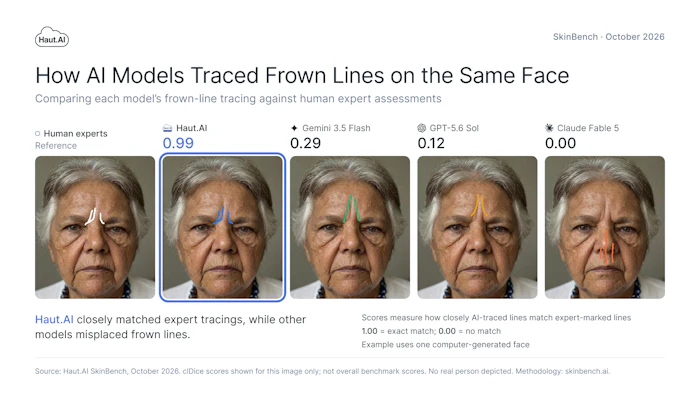
Haut.AI SkinBench comparison of how human experts, Haut.AI, and three leading AI models identified frown lines (vertical wrinkles between the eyebrows) on the same computer-generated face. Haut.AI closely matched human experts (0.99), while Gemini 3.5 Flash (0.29) and GPT-5.6 Sol (0.12) drew less accurate lines. Claude Fable 5 incorrectly marked the nose and mouth (0.00). Scores measure alignment with expert annotations, with 1.00 indicating an exact match.
The Haut.AI’s SkinBench benchmark reveals that six leading AI models incorrectly detected eye puffiness in 95% to 100% of images where it was absent, compared with an approximately 18% false detection rate for Haut.AI’s specialized skin analysis, powered by SkinFM. The findings highlight significant accuracy differences between these models and specialized skin analysis technology.
The Haut.AI’s SkinBench benchmark reveals two major AI skin analysis accuracy challenges: false positives and missed detections. Six leading AI models falsely identified eye puffiness in 95% to 100% of images where none was present, while the lowest-scoring model missed 85% of deep forehead wrinkles. Haut.AI’s specialized skin analysis, powered by SkinFM, recorded an approximately 18% error rate in both tests.
Haut.AI also released SkinBench, a new public benchmark showing that six leading AI models, including models from Google, OpenAI and Anthropic, frequently identify skin concerns that aren't actually present or fail to detect concerns that are. While popular AI models can recognize faces and describe visible features, the SkinBench results suggest they may struggle to assess skin accurately, potentially leading to inaccurate skin assessments and recommendations.
Haut.AI vs. Six Leading AI Models on SkinBench
In testing conducted through Haut.AI's new public SkinBench benchmark, six leading AI models – general-purpose models from Google (Gemini 3.5 Flash), OpenAI (GPT-5.6 Sol), Anthropic (Claude Fable 5), xAI (Grok 4.6) and Alibaba (Qwen 3.8 27B), as well as Google's medically specialized multimodal AI model, MedGemma (27B) – incorrectly identified eye puffiness in approximately 95% to 100% of images where it wasn't present.
The models also struggled to find wrinkles and identify skin types (such as dry, oily or combination). When asked to mark frown lines on a face, one leading model marked the nose and mouth instead, while another drew no lines on a test image.
In contrast, Haut.AI's model found 82% of deep forehead wrinkles, compared with 15% to 60% for the other models, and scored 78% balanced accuracy, which weights each skin type equally, compared with 37% to 58% for the other models.
Overall, Haut.AI's technology scored 69.6 out of 100 on the SkinBench Skin Intelligence Score, a 0–100 measure of skin analysis accuracy and task completion, where 100 means perfect agreement with expert assessments on every image, compared with 50.6 for Gemini 3.5 Flash, the highest-scoring general-purpose AI model.
Why Skincare Needs AI Built Specifically for Skin Analysis
The results come as businesses increasingly turn to AI designed for specific industries and tasks rather than relying exclusively on leading models. In April 2025, Gartner predicted that by 2027, businesses would use smaller, specialized AI models at least three times as often as general-purpose large language models.
NielsenIQ found that 49% of consumers have taken beauty product recommendations from GenAI. Reliance is deepening: Accenture found 75% of beauty consumers say they are open to an AI-powered shopping experience. That openness extends to skincare, with Haut.AI's survey of 1,238 U.S. women found that 62% of U.S. women are interested in or already use AI for skincare or bodycare advice, and half said they would trust AI for bodycare product recommendations.
"AI can recognize a face, but that doesn't mean it can accurately assess the skin," said Anastasia Georgievskaya, CEO and co-founder of Haut.AI. "Our findings show that some of today's leading AI models frequently detect skin problems that don't exist. That's a serious concern as consumers increasingly rely on AI for skincare advice. We developed SkinFM to make skin analysis more accurate and created SkinBench so the industry can see how different AI models actually perform."
What SkinFM Does: A Skin Analysis Foundation Model for Beauty Brands
Unlike traditional AI systems that require separate models for different skin analysis tasks, SkinFM uses a single, image-based AI foundation to analyze multiple skin characteristics. This approach also enables Haut.AI to develop new skin measurements faster and create customized grading systems tailored to individual brands' needs. Haut.AI's technology can assess more than 230 skin measurements and 48 biomarkers, including wrinkles, redness, pigmentation and other visible skin characteristics.
For beauty brands, this means they can tailor skin assessments to their products and customer needs, introduce new measurements faster, make more informed personalized recommendations, track visible improvements over time, and support skincare research and product development.
SkinBench Results: How Six Leading AI Models Performed on Skin Analysis
SkinBench compares Haut.AI's specialized skin analysis technology with Gemini 3.5 Flash, GPT-5.6 Sol, Claude Fable 5, Grok 4.6, Qwen 3.8 27B and MedGemma 27B. Developed by Haut.AI's Data Science team, the benchmark evaluates the models across 19 tests covering seven common skin concerns and characteristics: wrinkles, sun spots, redness, skin tone, skin type, dark circles and eye puffiness. Eleven tests identify and grade visible skin features, and eight measure how accurately models locate those features. Results are compared against reference assessments prepared by experts.
Five SkinBench findings reveal how much performance can vary and why these differences matter:
- Specialized AI came closest to human experts on a specific wrinkle assessment. Haut.AI scored 0.82 for agreement with expert assessments of frown-line severity, compared with 0.73 for GPT-5.6 Sol and 0.86 for human graders. The results, based on 350 computer-generated faces, suggest specialized AI can approach human-level consistency on certain narrowly defined skin analysis tasks.
- AI frequently detected skin problems that weren't there. As the eye-puffiness results illustrate, inaccurate AI skin assessments could lead to unnecessary product recommendations, wasted spending and diminished confidence in beauty brands' personalized skincare services.
- Identifying wrinkles isn't the same as accurately locating them. When asked to trace frown lines on 350 synthetic faces, Haut.AI scored 47.8 out of 100, compared with 20.2 for GPT-5.6 Sol, the strongest competing model. The difference matters because brands need to know where wrinkles are located to measure changes and assess product results.
- AI models struggled to classify skin types consistently. Haut.AI scored 77.8 out of 100 for skin-type classification, compared with 57.7 for the strongest competing model. Incorrectly identifying someone's skin type could affect recommendations for moisturizers, cleansers and other skincare products.
- Accuracy varied across skin tones. Haut.AI earned a score of 50.9 for performance across different skin tones, compared with 30.3 for the next-best general-purpose AI model. The score focuses on each model's weakest-performing eligible skin-tone group, highlighting why brands need to make sure their technology works reliably for consumers with different complexions.
Haut.AI did not outperform every model on every test. For example, Gemini 3.5 Flash performed better at grading crow's feet, the fine lines around the outer corners of the eyes (71.7 versus 61.8) and assessing skin tone (90.4 versus 87.6). These results reinforce the importance of evaluating AI tools on the specific tasks they are expected to perform rather than relying on a single overall score.
SkinBench's public leaderboard provides separate scores for different skin analysis capabilities and performance across skin tones. This lets companies compare models on the capabilities most relevant to their needs.
Haut.AI has plans to expand SkinBench with additional AI models and new tests that examine whether models produce consistent results when analyzing the same skin concerns.
"As AI becomes more common in beauty, brands need proof that the technology behind their recommendations can deliver reliable results," said Georgievskaya. "A false detection isn't just a technical mistake. It can lead to inappropriate product recommendations, unnecessary purchases and a loss of consumer trust. Our goal is to give brands the evidence they need to choose AI technology that earns and maintains consumer trust."
View the SkinBench leaderboard, model comparisons and testing methodology at skinbench.ai.