The spa and wellness industry stands at a transformative crossroads where precision technology meets personalized care. With the global medical spa market projected to expand from $17.2 billion in 2023 to $59.4 billion by 2033, wellness professionals are discovering that technology amplifies rather than replaces human expertise. Three innovators share how their technologies are reshaping treatment rooms while elevating guest experiences.
This article is only available to registered users.
Log In to View the Full Article
The spa and wellness industry stands at a transformative crossroads where precision technology meets personalized care. With the global medical spa market projected to expand from $17.2 billion in 2023 to $59.4 billion by 2033, wellness professionals are discovering that technology amplifies rather than replaces human expertise. Three innovators share how their technologies are reshaping treatment rooms while elevating guest experiences.
Precision Fit Technology: Solving the Measurement Problem
Aurelia Edwards, a polymer chemist with a master's degree in cosmetic science and more than 25 years in the beauty, spa and wellness industries, recognized that the nail industry faced a fundamental challenge. Beautiful designs consistently fell short due to imperfect fit, creating unnecessary waste and compromising client confidence.
Through Standard Measure Technologies and the NailQ platform, Edwards brought computer vision and photogrammetry into the treatment room. The technology maps each nail's dimensions and curvature with sub-millimeter accuracy using only a phone or tablet. Within two minutes, clients scan a QR code, hold their hand to the camera and receive a complete sizing profile.
"The goal was never to add steps; it was to remove friction, reduce waste and give people the quiet confidence that comes from a flawless fit," Aurelia explains. For operators, setup requires minimal disruption with a QR placard at reception or a tablet on the counter that integrates seamlessly into existing processes.
The technology unlocks new revenue opportunities through personalization. The sticker sets are sized to each guest, limited-edition press-on drops and maintenance kits drive repeat purchases beyond the treatment room. Spas can bundle sizing plus quick-apply sticker services as express menu items or pre-size event packages for weddings and retreats.
Broader pilots have shown 300% higher engagement with fit-matched options, approximately 25% higher repeat purchase rates and roughly 30% growth in average order value. Professionals report having more room for artistry because the fit is already handled. Edwards is expanding precision from fingers to toes, with precision-fit pedicures slated for Q1 2026.
LED Innovation: Transforming Lash Services
Soo-Jin Yang, founder and CEO of illumino Lashes based in Las Vegas, solved lash retention issues by reimagining adhesive technology. Inspired by childhood memories of LED devices curing bonding agents on clear braces, Yang spent years developing what became the Lynk-Gel Method, the world's first patented LED lash extension system.
Traditional lash applications relied heavily on room humidity and temperature, leading to frustration with slow-drying glue, unpredictable retention and fumes that caused eye irritation. After years of research and development, Yang launched the Lynk-Gel LED device and adhesive system, engineered and certified to global safety standards of IEC 62471 and ANSI RP-27 photobiological safety standards. The system uses an LED that peaks in the visible-light wavelength, curing the adhesive in seconds and creating a bond that resists oils, lotions and makeup while remaining gentle on natural lashes.
The impact on client experience proved immediate and measurable. "Clients immediately notice the difference: longer-lasting, gentler and softer adhesive with virtually no fumes, no stinging and no waiting to get lashes wet," Yang stated. The Lynk-Gel curing method uses a pinpoint LED precisely at the lash-to-lash bond, not on the skin, ensuring each natural lash remains healthy and able to grow and shed in its natural cycle.
For lash professionals, the technology offers total control and predictability. Each lash bond sets instantly, allowing artists to create clean, smooth bonds; advanced lash mapping and reduced service time while maintaining stunning retention results. On average, clients experience up to six weeks of lash retention, meaning fewer fill appointments and happier, long-term clients.
Since the 2019 official launch, illumino-certified lash artists reported significant improvements in both artistry and business performance. Service times reduced by up to 25%, and client retention soared. For studio owners, increased appointments per day and loyal returning clients translated directly to revenue growth.
LED therapy represents broader market momentum, with the global B2B market projected to reach $491.6 million by 2033. Clinical studies demonstrate that over 90% of participants showed a reduction in skin roughness and wrinkle depth after LED treatment courses.
Yang emphasizes that safety remains paramount. "The lash industry is rapidly evolving, and artists deserve technology that meets international safety standards, not just marketing claims," she notes. The future of the treatment room lies in merging human artistry with intelligent technology: devices and materials that are safer, faster, stronger and smarter.
Unified Systems: Creating Calm Through Integration
Moshe Edri, CEO of SpaSphere.ai, approached wellness technology from a different angle. With over 15 years of experience working in startups across a range of technologies and extensive technical experience leading teams of DevOps engineers, Moshe recognized that technology had become a double-edged sword for estheticians. Tools meant to create freedom often added noise, forcing professionals to juggle five or six different apps to keep spas running.
Through conversations with estheticians, Edri saw the struggle firsthand. Booking, payments, notes, inventory, websites and marketing all lived in separate worlds that rarely connected, leaving estheticians to sync everything manually. "The problem wasn't effort, it was design," Edri explains. "Our industry has been flooded with single-purpose apps that don't talk to each other, leaving professionals overwhelmed by tech instead of supported by it."
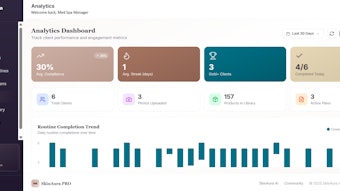
A new generation of AI tools is shifting that dynamic by working quietly and automating busywork so estheticians can focus on touch, connection and care. Modern systems provide digital briefs highlighting who's coming in, their goals, notes from the last visit and suggestions for upselling services or products clients already love. Professionals walk into treatment rooms informed and present, not distracted by paperwork or screen-hopping.
AI-assisted SOAP notes now take just two or three minutes to complete, capturing key insights during or after each session while tracking usage for cost analysis and client safety. When visits end, systems automatically generate branded follow-up emails in the esthetician's own voice, summarizing regimens, suggesting retail items and offering one-click rebooking.
Early adopters of connected approaches are seeing measurable impact: faster note completion, higher rebooking rates and less cognitive overload. "When the esthetician feels calm and confident, the guest senses it," Edri notes. "Treatments feel more present, conversations flow naturally and the professional's energy returns to what truly matters: care and craft."
The industry is entering a new chapter defined not by more technology but by harmony between tools and touch. At SpaSphere, the philosophy remains simple: the best technology whispers, not shouts. AI's role is not to replace connection but to preserve it, giving professionals more time, presence and calm.
The Future of Treatment Rooms
Across these innovations, a common thread emerges. Technology enhances the guest experience by removing friction, increasing precision and giving professionals greater capacity for artistry and connection. Whether through measurement accuracy, adhesive innovation or unified systems, the treatment room of the future adapts to each client while preserving the human expertise that defines exceptional wellness care.
As consumers continue demanding measurable, personalized experiences, wellness professionals equipped with intelligent technology are positioned to meet and exceed expectations. In treatment rooms where technology whispers and human connection remains central, true innovation happens.