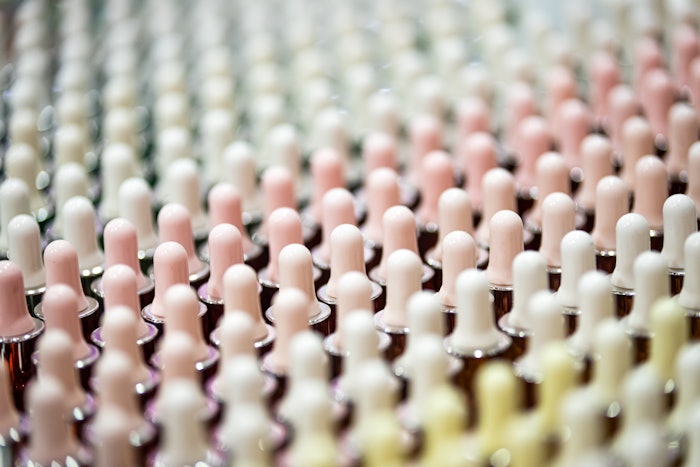
The beauty industry, like many global sectors, has faced significant challenges amid the uncertainties brought about by U.S. tariff policies. But savvy beauty contract manufacturers are leveraging diversified sourcing, emerging AI systems, regionalized strategies and more to survive and thrive. Here's what that looks like in practice.
 Korean manufacturer Kolmar Korea
This article is only available to registered users.
Log In to View the Full Article
The beauty industry, like many global sectors, has faced significant challenges amid the uncertainties brought about by U.S. tariff policies. But savvy beauty contract manufacturers are leveraging diversified sourcing, emerging AI systems, regionalized strategies and more to survive and thrive. Here's what that looks like in practice.
Global Beauty Supply Chains: Tariffs, Trade Flows and Evolving Strategies
Korean manufacturer Kolmar recently opened its second U.S. factory in Scott Township, Pennsylvania, which effectively expanded its tariff-free production base.Kolmar Korea
Meanwhile, Kline + Co. reportsb, "In 2023, the trade flow of cosmetics from the EU to the United States amounted to USD $4.96 billion, according to the Fédération des Entreprises de la Beauté (FEBEA), France’s beauty association."
That makes France the top fragrance and cosmetics exporter to the U.S. market, trailed by Italy, Spain, Germany, and the Netherlands.
Recently, Reutersc reported that top European beauty brands were considering the use of an old U.S. customs clause, known as the "First Sale" rule, to mitigate the financial impact of tariffs imposed by the U.S. government.
The rule, which dates back more than 30 years, could provide a way to reduce tariff costs on goods imported into the United States.
According to law firm Miller & Chevalier, under the "First Sale" rule, companies involved in multi-tiered transactions can use the price paid in the initial sale—such as from a foreign manufacturer to a middleman—as the basis for customs valuation. This initial transaction value is often lower than the final sale price to U.S. importers, resulting in reduced tariffs.
Meanwhile, Korea, another top beauty manufacturing hub, recently got hit with a 15% tariff, which comes just as K-beauty experiences a resurgence in the U.S. market. Per a BBCd report, "Americans spent as much $1.7bn (£1.3bn) on K-beauty products in 2024, according to industry estimates. That marks a more than 50% rise compared to the previous year."
Given the tough tariff rate, it was perhaps ideal timing for Korean manufacturer Kolmar to open its second U.S. factory in Scott Township, Pennsylvania, which effectively expanded its tariff-free production base for K-beauty brands seeking to expand in the West, as well as regional brands seeking Korean manufacturing expertise.
These production hubs tell just a part of the story, highlighting a complex, ever-evolving supply chain puzzle facing brands, their manufacturing partners, suppliers and of course consumers.
To get the view from America, Global Cosmetic Industry spoke to Chris Staples, CEO, Cohere Beauty, a custom development manufacturing organization (CDMO) for beauty, personal care fragrance and specialty products. The executive highlighted the need for diversified sourcing strategies, AI and automation in this unique moment facing the industry.
Here's what she had to say.
Adapting to Trade Changes with Diversified Sourcing
 "The day after the election, we launched a dedicated ‘tariff war room’ that meets weekly and brought on a licensed customs broker to navigate evolving trade dynamics," says Chris Staples, CEO, Cohere Beauty. Cohere Beauty
She adds, "We’ve diversified sourcing to other regions. For our core business of innovating, developing and producing products for our partner brands, we are helping shift packaging production from China to North America, including the U.S. and Mexico. For several brands, we’re also transitioning to PCR packaging made in the U.S."
Staples' organization is also managing raw material costs amid evolving tariffs and trade dynamics.
"On the raw material front, the impact has been muted so far," says Staples. "Many highly efficacious actives come from Europe, and it seems tariffs on items coming from Europe are going to stabilize at 15%. Our plan of attack is equally purposeful, we’re leveraging economies of scale, negotiating with suppliers, and closely monitoring costs, feedstocks and trade dynamics to mitigate increases wherever possible. In some cases, when all else fails, we will have to pass along a price increase to our customers."
Some Global Brands Shift Production to the US for Cost and Trade Advantages
 "Cohere Beauty is primarily a North American manufacturer, with three U.S. facilities," says Chris Staples, CEO of Cohere. "We work with our brand partners to strategically select a location based on capabilities rather than geography. Pictured is a body care concept range produced by Cohere Beauty.Cohere Beauty
"Cohere Beauty is primarily a North American manufacturer," the executive says, "with three U.S. facilities. We work with our brand partners to strategically select a location based on capabilities rather than geography. We are seeing growing interest from brands in Europe and China to shift production to the United States, largely driven by cost considerations, particularly tariffs."
Staples adds, "Qualifying a new CDMO is a lengthy, complex process, so these moves aren’t made lightly. For most of our partners, producing in the U.S. and shipping globally remains advantageous, especially given the fact that these trade agreements are largely favorable for the U.S., so we don’t anticipate that shifting in the near term."
How AI and Automation Are Giving Beauty Manufacturing a Glow-up
Manufacturers' capabilities are getting a makeover. For instance, Cohere Beauty is leveraging automation and AI to transform its supply chain and manufacturing processes, driving efficiency, adaptability and sustainability.
Staples notes, "Cohere Beauty is on an ongoing automation and AI journey across our supply chain and manufacturing network. In areas where labor is constrained, we’re strategically investing in automation to maintain efficiency and meet growing demand for domestic production."
She adds, "We’re also exploring how to leverage AI for predictive maintenance, real-time quality control, and demand forecasting, helping us reduce downtime, improve consistency, and respond more quickly to shifts in the market. In beauty and personal care manufacturing, we see increasing adoption of AI-driven batch optimization, automated filling and packaging, and smart vision systems to ensure precision and speed. These investments not only help address labor challenges, but also enhance flexibility, speed-to-market and sustainability."
How Tariffs and Regionalization Could Reshape the Global Beauty Industry
Meanwhile, the global beauty industry faces potential shifts in production and supply chains as tariffs and regionalization trends influence manufacturing decisions.
"Fragrance remains one of the most Europe-centric categories, with roughly 70% of fragrance oils and production based there," says Staples. "Tariffs on imports to the U.S. could drive shifts, but fragrance supply chains are highly complex, and moving production is rarely straightforward."
She adds, "Prestige and luxury skin care presents another on-shoring opportunity, with ingredients sourced globally, but much of the finished goods production still concentrated in Europe, Korea and emerging markets."
Staples concludes, "While tariffs may incentivize some brands to explore U.S. manufacturing, these transitions take time and careful qualification. We expect movement toward regionalization in select cases, but it won’t be a wholesale shift overnight."
Consumer Spending Shifts Amid Geopolitical Uncertainty
There are other considerations to keep in mind, of course. For instance, consumers are prioritizing needs over wants, cutting back on spending, and seeking deals or smaller pack sizes due to low confidence and economic uncertainty.
"We do see that our brands are concerned about geopolitical uncertainty—consumer confidence is at an all time low," says Staples. "Increasingly, consumers are weighing needs versus wants when making purchasing decisions and working through what they already have at home, holding off on new purchases and visiting stores less often to avoid unnecessary spending. Lower-income consumers are seeking price promotions and smaller pack sizes to stretch budgets between paychecks, while higher-income shoppers may be hunting for deals as well."
Footnotes
awww.personalcarecouncil.org/about/economic-and-social-impact/
cwww.gcimagazine.com/brands-products/skin-care/news/22947084/does-beauty-have-a-tariff-workaround