High-precision beauty ingredient company, Givaudan Active Beauty, announced its partnership with award-winning AI and skin intelligence company, Haut.AI this past April 7, 2026, spotlighting a new era of AI-driven ingredient innovation.
 Haut.AI x Givaudan Active Beauty at in-cosmetics Global in ParisHaut.AI
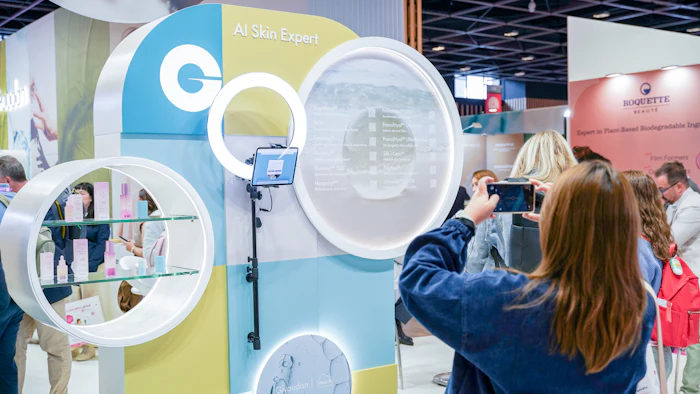
Givaudan Active Beauty then went on to become the first to showcase its latest active ingredients through immersive GenAI-powered activations at in-cosmetics Global 2026 in Paris April 14–16.
Related: Haut.AI Expands AI Skin Intelligence With Givaudan Partnership
As generative AI moves deeper into clinical workflows, product development, and consumer-facing consultation tools, the conversation is no longer limited to innovation potential—it is centered on measurable impact, data integrity, and how brands translate efficacy into experiences that patients and consumers can actually understand.
To explore these shifts further, MedEsthetics spoke with Haut.AI CEO and Co-Founder Anastasia Georgievskaya about the evolving role of AI in skincare personalization, clinical testing, and aesthetic practice, and what it signals for the next phase of beauty technology.
Q&A: Anastasia Georgievskaya, CEO & Co-Founder, Haut.AI
How is AI changing the way ingredient efficacy is demonstrated to both consumers and enterprise beauty partners?
Anastasia Georgievskaya: Primarily, AI is changing how ingredient efficacy is communicated, from something consumers can simply read about into something they can actually see and experience for themselves.
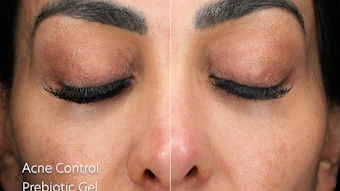
Until recently the industry relied on clinical charts, static before-and-after images, or abstract claims that were difficult for consumers to personally relate to. Today, we can take the results of clinical trials and turn them into a visible, individualized experience. Through technologies like Haut.AI’s SkinGPT, consumers can now actually see how a specific ingredient may influence visible skin parameters on their own face over time.
For enterprise partners, it’s also becoming a powerful communication and education tool. Ingredient suppliers and brands are looking for better ways to translate complex efficacy data into experiences that resonate emotionally while still remaining scientifically grounded. That’s exactly the direction we’re exploring together with Givaudan Active Beauty.
 Haut.AI x Givaudan Active Beauty at in-cosmetics Global in ParisHaut.AI
What demand signals are you seeing from large skincare brands around AI-powered personalization and diagnostic tools?
Anastasia Georgievskaya: Initially, many brands were exploring AI primarily from an engagement perspective. Today, they’re looking for end-to-end AI infrastructures that support the entire consumer journey.
What I’m hearing from brands is that they no longer want a single AI feature. They want a system that can support a clinical study and efficacy measurement, then use that same data to power the consultation, the recommendation, and the follow-up, all within one infrastructure.
The goal is no longer just to create a single AI feature, but to build truly personalized skincare experiences grounded in data, science, and continuity across every touchpoint.
How do you see generative AI reshaping the customer consultation experience inside medspas, clinics, and retail beauty environments?
Anastasia Georgievskaya: GenAI introduces the ability to create individualized visual journeys based on a consumer’s own face and skin condition.
In medspas and clinics, this can help improve patient understanding and confidence by showing realistic, parameter-based simulations of their own skin transformations rather than idealized, edited visuals. In retail beauty, it creates a more immersive discovery experience where consumers can explore products and routines in a highly personalized way.
Importantly, the future consultation experience will become more continuous. AI will not simply analyze skin once—it will support an ongoing dialogue between consumers, brands, clinicians, and products. That is part of the vision behind technologies like Skin.Chat.
Beyond engagement, what measurable business outcomes are brands seeing from AI skin analysis and simulation technologies?
Anastasia Georgievskaya: One of the clearest areas of value is AI-powered skin analysis in clinical and product testing workflows. At Haut.AI, we’ve been focused on making skin measurable at scale through clinically validated AI analysis.
AI allows clinical studies to be run more efficiently, on larger participant groups, and with more frequent longitudinal measurements over time. That means brands can generate richer efficacy insights while reducing operational complexity and cost. Remote and hybrid clinical studies also become more scalable because participants can submit images digitally while AI helps standardize analysis and reduce evaluator variability.
Regarding simulation technologies like SkinGPT, a recent example is our collaboration with Givaudan Active Beauty at in-cosmetics Global in Paris. We created an interactive experience where attendees could visualize how a new active ingredient may influence visible skin parameters on their own face over time.
Beyond attention, that kind of experience becomes a conversation starter, a lead generator, and a relationship-building tool—especially in enterprise beauty, where showing innovation matters as much as talking about it.
What makes SkinGPT different from the wave of AI beauty visualization tools currently entering the market?
Anastasia Georgievskaya: SkinGPT is the first technology of its kind capable of generating hyper-realistic skin simulations based on clinically informed skin parameters and efficacy data.
Most tools currently in the market apply generalized visual effects or aesthetic filters. They may create attractive transformations, but they are not simulating how skin evolves based on ingredient performance or product efficacy.
SkinGPT starts from an individual’s real skin baseline—texture, pigmentation patterns, wrinkles, redness—and models expected visible outcomes based on clinical study results or ingredient efficacy data.
So instead of applying the same effect to every face, SkinGPT creates a personalized skin journey for each individual user. Two people using the same simulation may see different outcomes because their baselines are different. That distinction is critical: the goal is not fantasy transformation, but scientifically grounded personalization.
And that is exactly what makes it compelling for brands. They’ve spent years proving efficacy in clinical settings. Now they can make that proof visible.
How important is clinically validated data when developing AI-powered skincare recommendations and simulations?
Anastasia Georgievskaya: It’s absolutely critical. True personalization is only possible when AI is built on large, diverse, and clinically meaningful datasets across age, gender, ethnicity, skin tone, and skin conditions. Otherwise, you’re not building intelligent personalization—you’re building a narrow approximation of it.
Haut.AI’s models are trained on more than 3 million skin images collected across diverse populations, and dermatology-informed labeling ensures the system aligns with real clinical evaluation rather than just visual pattern recognition.
Do you believe consumers are becoming more skeptical of traditional before-and-after marketing? How does AI simulation address that shift?
Anastasia Georgievskaya: I think the shift is already happening. Once people experience technologies like SkinGPT, traditional before-and-after marketing can start to feel outdated.
What AI simulation changes is that it moves the conversation from “here’s what happened to someone else” to “here’s how this may work for you.” That is a fundamentally different consumer experience—and expectations change quickly once people see it.