 "Our Erlanger, Kentucky campus, which is our flagship U.S. flavors facility, anchors this strategy, combining innovation, production and core technology capabilities in one location," says Hélène Moeller, vice president, global product marketing, flavors and colors.ADM
"ADM is strengthening capabilities to support key pillars of reformulation, including increased calls for clean labels," says Hélène Moeller, vice president, global product marketing, flavors and colors. "In fact, 70% of global consumers prefer products that contain ingredients they recognizea."
"Our Erlanger, Kentucky campus, which is our flagship U.S. flavors facility, anchors this strategy, combining innovation, production and core technology capabilities in one location," "ADM Recent investments of over $40 million are central to this effort. Significantly, a $26 million investment includes the 3,600-square-foot-expansion of an existing facility on site. This investment supports a 40% increase in capabilities for raw material handling and introduces automation, digitalization and integrated process improvements, all of which enhance capacity, consistency and delivery reliability for naturally derived colors and flavors."
Moeller adds, "To ensure a dependable pipeline of colors and flavors derived from natural sources, we rely on vertically integrated supply chains, direct farmer relationships and global sourcing diversification. This enables quality control from seed selection through extraction and formulation, supported by proprietary technologies that improve stability, shelf life and sensory performance. With many of our key global ingredients routing through our Erlanger hub, our investment in the facility supports our strategic goals while making these natural materials more accessible to our North American customers."
 "With our team of food scientists, formulation experts and culinary chefs taking advantage of our quality ingredient solutions library, such as our clean-tasting, highly functional plant-based ingredients, all at our new space at Erlanger, we provide an agile, collaborative environment for our customers to quickly and confidently deliver products that meet multiple nutritional, sensorial and clean-label goals," says Hélène Moeller, vice president, global product marketing, flavors and colors.ADM
She continues, "Some of the biggest industry challenges are upstream, most notably for naturally derived colors. As demand for ingredients from natural sources increases, pressure on agricultural inputs, crop variability and regional supply constraints can challenge availability and cost stability. Additionally, ensuring consistent quality and navigating varying global regulatory requirements adds complexity."
Regarding the variability of natural materials, Moeller explains, "To enhance batch-to-batch consistency in the manufacturing process, we rely on multiple factors. We start and finish with quality analytical inspection, from raw materials that we create with to finished ingredients that go out the door to our customers, which then get incorporated into their finished beverage products. With the variability of natural raw materials, we rely on our analytical database to help predict or recommend any adjustments that need to be made in production. During the manufacturing process, we utilize the accuracy of electronic systems to precisely weigh raw materials and flag any potential issues that may throw production outside of the required and stringent specifications we adhere to. The design of automated dispensing of ingredients also allows for sensitive raw materials to be handled with care to reduce oxidation, prolonging consistent quality."
 Sodium reduction is no longer just about lowering salt levels, but preserving emulsification, shelf life, and umami perception through tools like TasteSpark salt modulation systems that can reduce sodium by 25–30% in savory applications.ADM
She concludes, "Ultimately, success in this space depends on combining strategic planning, sourcing expertise, scientific innovation and expanded capacity handling for formulation flexibility to proactively manage these constraints while meeting growing clean-label demand."
The flavor facility investment builds on a prior expansion of ADM’s Customer Creation and Innovation Center and is aimed at strengthening co-creation capabilities with brand partners across food and beverage categories.
 "ADM’s expertise in rapidly iterating flavor modulation systems for sugar and sodium reduction comes more from the formulation know-how of flavorists working hand in hand with application specialists, validating sensory effects with trained teams of panelists," says Moeller.ADM
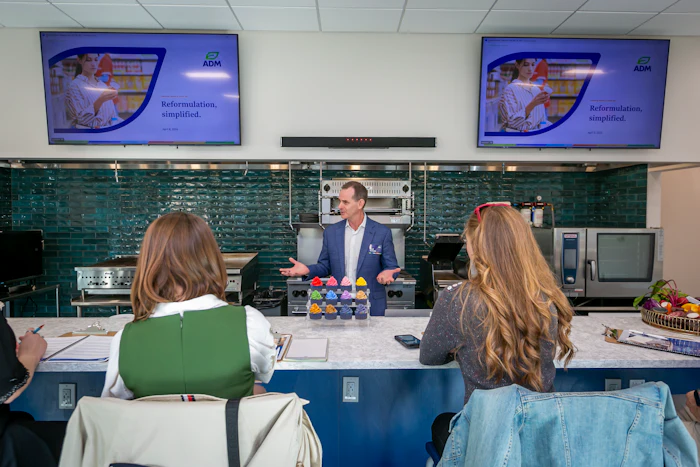
"The $15 million expansion of our 7,200 sq. ft. Customer Creation & Innovation Center (CCIC) strengthens collaboration with customers, fast-tracking reformulation across food and beverage applications," says Moeller. "By bringing product development, pilot and production capabilities closer together, we can move seamlessly from concept to commercialization. Customers can collaborate on formulations with us in the CCIC, leveraging our culinary and application expertise, and then quickly validate those solutions through sensory testing."
She continues, "That’s particularly valuable for multi-dimensional challenges like reducing sugar or sodium while adding protein, where every adjustment impacts taste, texture and functionality. With our team of food scientists, formulation experts and culinary chefs taking advantage of our quality ingredient solutions library, such as our clean-tasting, highly functional plant-based ingredients, all at our new space at Erlanger, we provide an agile, collaborative environment for our customers to quickly and confidently deliver products that meet multiple nutritional, sensorial and clean-label goals."
 At the core of ADM's strategy are five reformulation pillars shaping product development globally: cleaner labels, reduced sugar, reduced sodium, increased protein and optimized fats. ADM
At the core of ADM's strategy are five reformulation pillars shaping product development globally: cleaner labels, reduced sugar, reduced sodium, increased protein and optimized fats. The company's approach combines naturally derived ingredients, flavor modulation system and functional nutrition solutions to maintain taste, texture and indulgence while improving nutritional profiles. The expansion underscores how reformulation has become a central driver of food innovation, requiring integrated solutions that balance sensory performance, regulatory compliance, and evolving consumer demand for better-for-you products.
"ADM’s expertise in rapidly iterating flavor modulation systems for sugar and sodium reduction comes more from the formulation know-how of flavorists working hand in hand with application specialists, validating sensory effects with trained teams of panelists," says Moeller. "Aligned with a common language around sweetness, savory and sodium perceptions, our teams have starting points for development that we can quickly adjust to the customers’ unique challenges in application as it relates to fine-tuning taste, onset and aftertaste. With our expertise, we can decrease the length of reformulation project length to help get our customers to market faster with validated solutions."
 "Aligned with a common language around sweetness, savory and sodium perceptions, our teams have starting points for development that we can quickly adjust to the customers’ unique challenges in application as it relates to fine-tuning taste, onset and aftertaste," says Moeller.ADM
She adds, "The upgrades at our Erlanger facility function to increase the efficiency and consistency of manufacturing these solutions for our customers. Flavor modulation formulations are often more complex than typical flavors, with impactful raw materials needing to be dosed at parts per million or even parts per billion. Leveraging automation to make this dosing more efficient and accurate helps ensure quality, complementing the expertise of the skilled operators overseeing manufacturing."
Moeller continues, "This is critical as reduction targets intensify. Americans consume about 3,400 mg of sodium daily, which is well above the 2,300 mg recommendation, and the FDA’s 2024 draft guidance aims to cut intake by ~20% across various categories. At the same time, eight in 10 global consumers are actively reducing sugarb. Plus, our research finds 65% of U.S. consumers prefer brands reformulate existing products to align with better-for-you positioningc. These shifts toward less sodium and less sugar and overall better-for-you attributes require highly responsive formulation systems."
The executive notes, "Our upgrades enable a true systems-based approach. For sugar reduction, we leverage our Replace Rebalance Rebuild method, which replaces sweetness, rebalances flavor and rebuilds functionality. We can combine solutions like SweetRight Stevia Edge with complementary ingredients like tapioca starch or prebiotic fibers, then fine-tune sensory performance using advanced flavor technology."
 Beyond macronutrients, ADM highlights a broader evolution toward functional, “third culture” food and beverage design, where nutrition, wellness, and global flavor inspiration intersect.ADM
Moeller adds, "Our investments also help us deploy tools like TasteSpark flavor modulation, whether masking off-notes, restoring mouthfeel or rebuilding full taste profiles in reduced-sodium and -sugar products. Plus, TasteSpark flavor modulation can be labeled as 'natural flavor' on product labels, meeting clean label objectives. Faster iteration cycles allow us to optimize not just sweetness or salt perception, but the full sensory experience, including overall flavor and texture."
She concludes, "These capabilities let us move from concept to scalable solution more efficiently, helping customers deliver better-for-you products that maintain indulgent taste while meeting nutrition and clean label expectations."
The technical emphasis in reformulations is increasingly on multi-layered solutions rather than single-ingredient swaps—such as approaches in sugar reduction that combine high-intensity natural sweeteners like stevia, flavor modulation systems to mask off-notes, and functional fibers to restore mouthfeel and structure. Similarly, sodium reduction is no longer just about lowering salt levels, but preserving emulsification, shelf life, and umami perception through tools like TasteSpark salt modulation systems that can reduce sodium by 25–30% in savory applications.
Protein enrichment and clean label reformulation are also converging into a unified innovation space, where functionality and consumer perception must align. Soy and pea proteins continue to anchor formulation strategies due to their versatility and labeling advantages, while ancient grains and seeds are being used to add texture and nutritional density in bakery and snack formats. At the same time, demand for natural colors is reshaping visual formulation strategies, with botanical sources like turmeric, spirulina and black carrot increasingly replacing synthetic dyes—even in categories like confectionery where consumers are willing to trade visual precision for cleaner labels.
Beyond macronutrients, ADM highlights a broader evolution toward functional, “third culture” food and beverage design, where nutrition, wellness, and global flavor inspiration intersect. Emerging categories such as tri-biotic sodas, cognitive beverages, and relaxation-focused dairy products illustrate how gut health, mental wellness, and energy modulation are being built directly into product architectures. Across categories, the overarching takeaway is that reformulation is becoming a systems-level discipline—where nutrition, functionality, flavor, and consumer expectation must be engineered simultaneously rather than independently.
FOOTNOTES
aADM Outside Voice, Global Lifestyles Survey, 2025
bADM Outside Voice, Sugar Reduction Insights Tool, 2024
cADM Outside Voice, Reformulation Research, U.S., 2026