Editor’s note: This article is the final part of a three-part series about how cancer affects the skin, detailing clients from Ahava Spa and Wellness Center in Toledo, Ohio. The first part appeared in the March 2012 issue and addressed cancer and skin dehydration, and the second part covered altered sensation. Skin care professionals must seek specialized training before offering the services addressed in this series.
Eileen came to Ahava Spa and Wellness Center in Toledo, Ohio, worn down by her colon cancer. She had been dealing with surgery, chemotherapy and radiation therapy. Her daughter, Shelley, recalls, “Just two months after her 60th birthday, my mother—who had only ever been hospitalized to give birth to her five children—was diagnosed with Stage IV colorectal cancer that had metastasized to her liver. Her life as she knew it was no longer. It was all to change.”
Some of the drugs Eileen received to treat her cancer are known as targeted treatments. Targeted treatments are new technologies designed to block the mechanisms by which cancer cells are nourished, grow, divide and possibly spread. These targeted treatments are much smarter about blocking cancer cells without as many side effects as traditional chemotherapy.
There is one particular type of targeted therapy—epidermal growth factor receptor (EGFR) inhibitors—that block the cancer mechanisms while causing extreme skin dryness and an acnelike rash. In most cases, the rash appears on the face, scalp, chest, back and around the ears, and it may be intermittent. Some physicians may treat it with an antibiotic cream or pills and refer the client to a dermatologist; others may prescribe antibiotics prophylactically. Research continues to determine the best methods to prevent the skin side effects.1
There is evidence that suggests this rash corresponds to effective treatment; the rash signals the treatment is working against the cancer.1 Although not life-threatening, these skin changes are difficult and have caused some people to stop treatments.
Emotions and cancer
Cancer changes everything. As Eileen experienced, the changes to a person’s life are significant. People respond to cancer in different ways. (See Reactions to a Cancer Diagnosis.) Millions of Americans alive today have a history of cancer: for some, it is a chronic health problem; for others it has been cured; and for still others, it is the cause of death. Finding ways to live with this diagnosis is important for all of these people.
Feelings vary from person to person, and within the same person. These may include hope, denial, anger, fear, stress, anxiety, depression, sadness, guilt, loneliness and gratitude. All these feelings are normal. Many people report that the time between finding out they have cancer and the final plan for treatment—which may be separated by weeks because of tests that need to be completed—is one the most difficult times. Other times of high distress are at the beginning and end of treatment, during times of recurrence and after being told the cancer is terminal. More information about emotions and coping mechanisms associated with cancer is available at the following websites:
Consider the emotional impact from the loss of control of personal information. When you meet someone new, many choices are made about what you want to reveal about yourself. Will you tell this person your age? Your marital status? If you have children? Your religion? How about your political views? That you have high blood pressure? While undergoing treatment for cancer, some of a client’s personal privacy is lost. A bald head, even one with a wig on it, is difficult to hide. Surgical scars, acne, skin color changes along the veins … all of this is difficult to hide satisfactorily. The visibility of these conditions make people feel forced to reveal their cancer diagnosis by way of an explanation.
A special guest
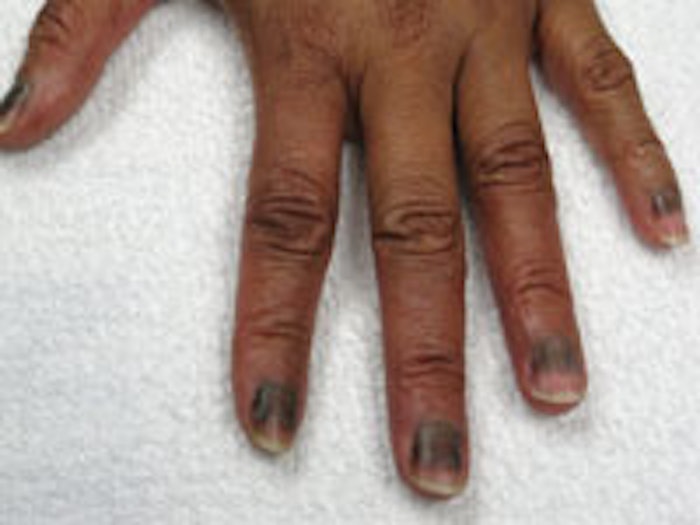
As Eileen’s cancer treatment continued for weeks and months, the cancer seemed destined to stay. “This cancer had definitely taken over my once-energetic, -enthusiastic and -vibrant mother. She had become her cancer. The toll was both physical and emotional. She looked like the cancer—from her chemo port in the left side of her chest to her ileostomy on her abdomen. Other treatment side effects were strikingly evident: painful and peeling hands and feet, swelling from steroids and chemo acne,” remembers her daughter. Eileen was exhausted and tired of sharing her body with the medical community. (See Treatment-induced Appearance Changes for possible skin changes that may be experienced by cancer clients.)
1. Initial assessment and analysis. Eileen experienced several ways cancer changed her appearance and affected her self-esteem. Certainly any of these individually are challenging and together they can be overwhelming. At the time of her visit to Ahava, Eileen was experiencing the following.
- Hair loss—both scalp and facial hair
- An abdominal scar with an ileostomy that continually drained stool into a pouch on the side of her abdomen
- An access port for chemotherapy implanted just under her left collar bone
- An acnelike rash on her face and upper back
2. Preparation and approach. When a client comes to a spa, skin care professionals must direct their attention first to basic grooming. The value of this skill and expertise brought to the situation at hand cannot be overstated. Eileen was approached by the spa team with support and respect. She had been through a lot and much in her life had changed. It was important that she feel safe. Even just going to a spa was new for her; she had never even had polish on her toenails before.
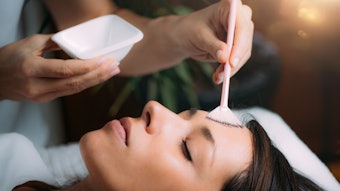
The first step was to address the acne without compromising the integrity of the skin. Specifically, no extractions would be performed. Chemotherapy-induced acne is different than hormonal or puberty-induced-acne. Because the skin is still compromised, care and treatment must be gentle. Camouflage rather than correction is the goal. Eileen’s acne treatment would be comprehensive but less aggressive because of the compromised skin.
3. Treatment. If this type of skin is treated too aggressively or harshly, there is the risk of scarring. Bleaching and extractions cannot be used, so Eileen’s protocol included the following.
- Cleanse skin.
- Steam pores open.
- Exfoliate with mild exfoliant and facial brushes using warm towels to draw out active acne.
- Massage with a mask to promote and return a natural balance to the skin.
- Use a low dose of high frequency to close down and seal pores.
- Apply a second mask to infuse moisture into the skin and support its health.
- Finish with a serum and a moisturizer.
Evaluation and follow-up. According to Katie Morgan-Lousky, Ahava owner and esthetician, “Besides teaching her how to draw in her eyebrows, we gave Eileen a way of coping. We could not correct the discoloration and acne, but we could make her look and feel better.”
From Shelley: “Everything was the cancer. Cancer became her identity. That is, until the day when mom received her ‘cherished’ spa day. From the moment she arrived at Ahava Spa and Wellness Center, she was no longer her cancer. She was treated as the incredible queen that she was. The staff talked to her about everything but her cancer. She glowed for the first time in two years. She was so peaceful and beautiful when she arrived home.”
Cancer changes everything
Although the skin side effects of cancer treatment are not usually life-threatening, their influence on self-esteem and quality of life should not be minimized. Cancer changes everything. The struggle to hold on to what is normal can be monumental. A spa day during which touch is comforting and results are positive is incomparable.
REFERENCE
1. M Polovich, JM Whitford and M Olsen, Chemotherapy and Biotherapy Guidelines and Recommendations for Practice, Third Edition, Oncology Nursing Society, Pittsburgh (2009)
Patricia Ringos Beach is a nurse with advanced certification in oncology and palliative care who works as a patient navigator and clinical nurse specialist.
Katie Morgan-Lousky is the owner of Ahava Spa and Wellness Center in Toledo, OH. She also founded Cherished Friends of Ahava, a spa ministry for cancer patients.
Both are instructors for Cancer & Skin Changes: How to Help, a one-day workshop open to skin care professionals, and can be contacted at 800-699-2579 or [email protected].