Editor's note: Skin Inc. magazine recommends that all clients check with their physicians before incorporating any dietary changes.
It’s not a myth—people are definitely comprised of the elements that they eat, which are absorbed into the bloodstream and feed every cell. Each month, people renew their skin, every six weeks they have a new liver, and every three months they have new bones. In order to renew and rebuild these organs and tissues, it is important to supply the body with the materials that have been lost as a result of constant use, degeneration and aging.
The problem is that human bodies are not getting enough nutrients to keep cells fed. The Standard American Diet (SAD)—an acronym that is most appropriate—is grossly inadequate and almost devoid of many nutrients. Americans are overfed and undernourished. Adding to the problem, many drugs interfere with the absorption of key nutrients. For example, tetracycline interferes with calcium, magnesium and iron absorption, and many antibiotics interfere with the absorption of B vitamins, while oral contraceptives and hormones reduce levels of water-soluble vitamins.
It has been well documented in scientific literature that nutrition can play a key role in skin health. In relation to skin disease and aging, the bad news is that poor nutrition can accelerate skin degeneration. The good news, however, is that a healthful diet that is complete with optimal nutrition can help forestall, prevent and even reverse skin conditions. Knowing this, it becomes clear that if you add an optimal nutrition plan to every skin care regimen, your clients can literally eat their way to healthier skin while they promote their total well-being.
What to eat
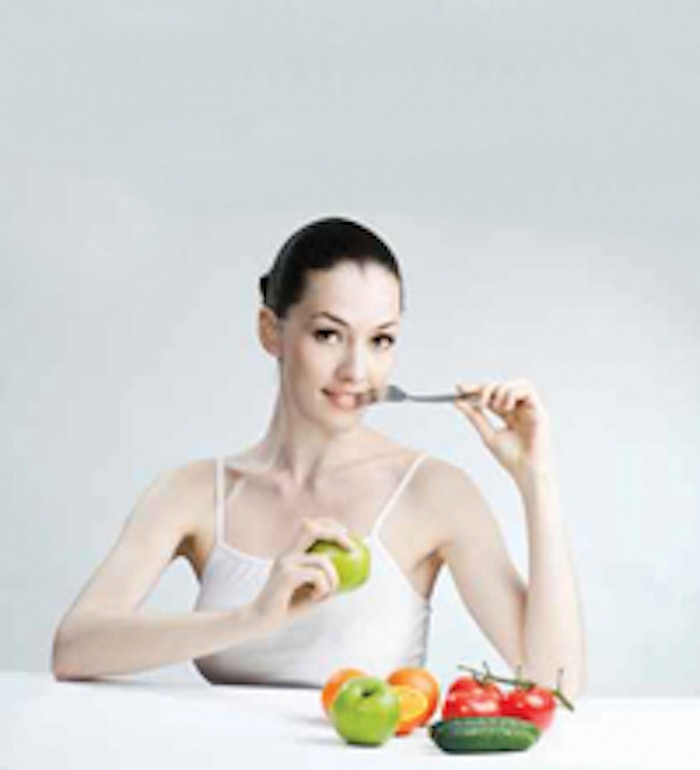
Nutritionists commonly advise people to eat a rainbow of fruits and vegetables every day. Whenever possible, they should be eaten raw. If they are cooked, they should be steamed to retain nutrients, or else lightly boiled. Even better, waterless cooking in the microwave preserves the most nutrients. Although many believe that organic foods are best, they may not always be available or cost-effective. In any case, there are 12 foods that should always be purchased as organic and 12 others that don’t have to be, says The Environmental Working Group (EWG).1
The following foods should be purchased as organic because they commonly are very contaminated with pesticides: peaches, apples, sweet bell peppers, celery, nectarines, strawberries, cherries, pears, imported grapes, spinach, lettuce and potatoes.
Onions, avocados, sweet corn, pineapples, mangos, asparagus, sweet peas, kiwi, bananas, cabbage, broccoli and papaya are consistently clean, according to EWG, and regularly don’t have any detectable pesticide residues.
In addition to fruits and vegetables, whole grains, lean proteins and healthy fats provide the nutrients the body needs for optimal nutrition. Moreover, consuming scientifically formulated dietary supplements can also be helpful because they offer the nutritional insurance needed to further optimize an individual’s personal nutrition profile. Supplements cannot replace foods, however, especially because good sources of fiber, such as fruits and vegetables, are sorely needed. Supplements should only be used to augment the diet. For supplement recommendations, see Daily Supplements.
Inflammation and cell water loss
Whether eaten in food form or taken as a supplement, an internal skin care program should incorporate plenty of anti-inflammatory foods and dietary nutrients. As a person ages, the body develops an ability to react disproportionately—either too much or too little—to what it perceives as an injury or invasion. Inflammation is really a sign that the body is attempting to protect itself. It is also a sign of cellular water loss. Inflammation causes cell damage and has been linked to countless conditions from Alzheimer’s disease to diabetes to heart disease, and even to wrinkles. When cells are not fully hydrated, they cannot function at optimal levels, and this leads to cell damage and aging. Additionally, when cells deteriorate, the immune response does not function well. So, based on this water principle, the collective idea is to reinforce cellular membranes, prevent cell water loss and encourage the accumulation of intracellular water to ensure that all cells and connective tissues function at their optimum levels. But drinking water isn’t the answer—the cells have to be fed. An anti-inflammatory diet will fortify connective tissues, cells and their membranes with the antioxidants, vitamins, minerals and lipids they need for quick healing, resiliency and supple, youthful skin.
Anti-inflammatory foods
Anti-inflammatory foods include those stocked with antioxidants, or brightly colored fruits and vegetables, and healthful, essential fatty acid (EFA)-rich protein. In skin cells, such as those found in the stratum corneum, EFAs in cell membranes actually enhance the immune system as they strengthen the skin’s barrier function. In other words, EFAs play a part in cutaneous immunity. Obtaining a large amount of EFAs through outside sources is essential to total health. In addition, alpha-linoleic and gamma-linolenic acids are ceaseless inflammation-stoppers, as is durian extract and even sulfur.
Alpha linoleic acid (ALA) works together with antioxidants, such as vitamins C and E. It is important for growth, helps to prevent cell damage, and helps the body rid itself of harmful substances. ALA is found in vegetables, beans, fruits, flaxseed oil, canola oil, wheat germ, brewer’s yeast, walnut oil and raw walnuts.
Gamma linolenic acid (GLA) is an EFA in the omega-6 family that is found primarily in plant-based oils. It is less common than ALA, but can be found in seed oils, such as borage, evening primrose, black currant and hemp.
Durian is another anti-inflammatory food that isn’t seen much in the United States. It’s a native plant to Asia that offers a one-two punch to inflammation. Together, the omega-3 EFAs and antioxidants in durian act synergistically as they moderate the induction of inflammatory mediators, decreasing free-radical tissue damage, and inhibiting collagen and elastin breakdown from matrix metalloproteinases (MMPs), natural enzymes in skin that degrade the skin matrix.
Early studies have also indicated that sulfur-containing foods such as garlic, onions, meat and cruciferous vegetables can offer anti-inflammatory and detoxifying benefits. Sulfur is found in every living cell in the body, and it plays a key role in collagen synthesis. For alternatives to common inflammatory foods, see Inflammatory Foods and Anti-inflammatory Alternatives.
Special concerns
Although inflammation-abating foods are good for cell health in general, there are some nutrients that are better than others for specific skin conditions.
Acne. Vitamin A helps normalize the production of excess skin cells that clog the pore within the follicles. Vitamins B-1, B-2, B-3 and B-6 assist with tissue growth and repair, and zinc helps reduce the inflammation of acne. Antioxidants such as grape seed extract also reduce inflammation from acne and free radicals.
Menopausal skin. Melatonin, in addition to regulating sleep, is a powerful antioxidant that helps protect nuclear and mitochondrial DNA. Glucosamine is the building block for the ingredients needed to heal or repair the dermis, as well as all of the rest of the connective tissue throughout the body. And gamma-aminobutyric acid, which is responsible for the regulation of muscle tone, is also a key nutrient.
Stressed skin. B vitamins and glucosamine are essential for tissue repair and healing, as is vitamin C, coenzyme Q-10 and pomegranate, which boosts skin’s natural SPF. In addition, oregano, an anti-inflammatory herb and curcumin, which comes from turmeric (found in curries), offer cell-protective and anti-cancer benefits. Zinc also relieves inflammation and EFAs strengthen skin cell membranes. Lecithin, which is mainly comprised of phosphatidylcholine, is also excellent for stressed or overprocessed skin because it is a major component of cellular membranes. Lecithin makes cell membranes strong, so intracellular water doesn’t leak.
The “pitcher” of health
Stepping away from the traditional idea of a food pyramid, consider the symbolism of a pitcher—a vessel that holds water. The food groups within the pitcher encourage intracellular water as they give the body the nutrients it needs to feed cells for overall health and youthful skin.
Fruits and vegetables. Fruits and vegetables form the base of the pitcher. More of these foods should be eaten than any other group—three or more servings a day of fruits, and five or more servings of vegetables. For example, a small- or medium-sized fruit, such as an apple, is one serving, and 1⁄2 cup of chopped vegetables is one serving. Fruits and vegetables are rich in phytochemicals, such as polyphenols, and are the healing antioxidants the body needs.
Whole grains. Whole grains (four to eight servings daily) should be the next level up in the pitcher. A serving would be one slice of whole grain bread or 1⁄3 cup of cooked brown rice. Avoid refined grains and carbohydrates. Whole grains are a source of magnesium and selenium. Magnesium is a mineral used in building bones and releasing energy from muscles. Selenium protects cells from oxidation, and it is also important for a healthy immune system.
Proteins. Proteins (four to six servings daily) should be the third level up inside the pitcher, and this includes fish rich in omega-3 fatty acids, white-meat chicken, eggs, soy foods, fat-free and low-fat dairy products, and beans. This should also provide most of the body’s amino acids. Avoid high saturated-fat meat products and whole-fat dairy foods. A serving would be one medium egg or three ounces of fish. Amino acids give the body all the raw materials it needs to build collagen and elastin, the two substances necessary for keeping the dermis and blood vessels firm, strong and smooth.
Healthy fats. Healthy fats should be limited to just three to four servings a day and are next up within the pitcher. One serving would be a teaspoon of olive oil or alternatively six almonds. Healthy fats are unsaturated, such as omega-3, -6 and -9 fatty acids, which are found in flaxseed oil, extra virgin olive oil, canola oil, natural-style nut butters, cold-water fish and nuts.
Supplements and water. Near the top of the pitcher is space for supplements and water to address any dietary deficiencies.
Bridging the nutritional gap
Most people do not even realize that the skin symptoms they see in the mirror and the fatigue they feel are the result of nutrient deficiencies. The precise amounts of nutrients that each person’s body needs to close the gap between what’s consumed and what’s missed can’t be known, but it is known that certain dietary nutrients can counteract inflammation, stress and neutralize free radicals. It’s important to remember that before there was medicine, there was food.
Although it is not an exhaustive list, the aforementioned nutrients offer an internal route to skin health. The best that can be done is eat well and take supplemental nutrients in amounts that are greater than can easily be consumed through foods, but not so much that imbalances are created or toxic levels reached. These changes can be part of a long-term, inclusive solution, augmenting current topical skin care regimens to improve the look of skin, while at the same time, increasing longevity and health down to the cellular level.
REFERENCES
1. www.ewg.org/node/8792 (Accessed June 17, 2009)
GENERAL REFERENCES
B Frei, Efficacy of dietary antioxidants to prevent oxidative damage and inhibit chronic disease, J Nutr 134 3196S–3198S (2004)
HL Hu, et al., Antioxidants may contribute in the fight against ageing: an in vitro model, Mech Ageing Dev. 121(1–3) 217–30 (Dec 20, 2000)
H Murad, The Cellulite Solution, St. Martin’s Press, New York (2005)
H Murad, Wrinkle-Free Forever, St. Martin’s Griffin, New York, (2003)
H Murad, M Tabibian, The effect of an oral supplement containing glucosamine, aminoacids, mineral, and antioxidants on cutaneous aging, J Dermatol Treat 12 47–51 (2001)
H Murad, J Jankicevic, Dietary Supplementation as a Nutrition Intervention Strategy to Increase Intracellular Water and Phase Angle, Orlando, FL, American College of Nutrition 48th Annual Meeting and Conference (2007)
H Murad, Thoughts on the Process of Aging, Cosmet Dermatol, 22(2) (2009)
H Murad, Lange D, The Murad Method, Macmillan, New York, (2003)
H Murad, VRW Shellow, Pomegranate extract both orally ingested and topically applied to augment the SPF of sunscreens, Cosmet Dermatol 14(10) 43–5 (2001)
P Ritz, Chronic cellular dehydration, J Gerontol, 56A(6) 349–352 (2001)
The Pitcher of Health
The "Pitcher" of Health